
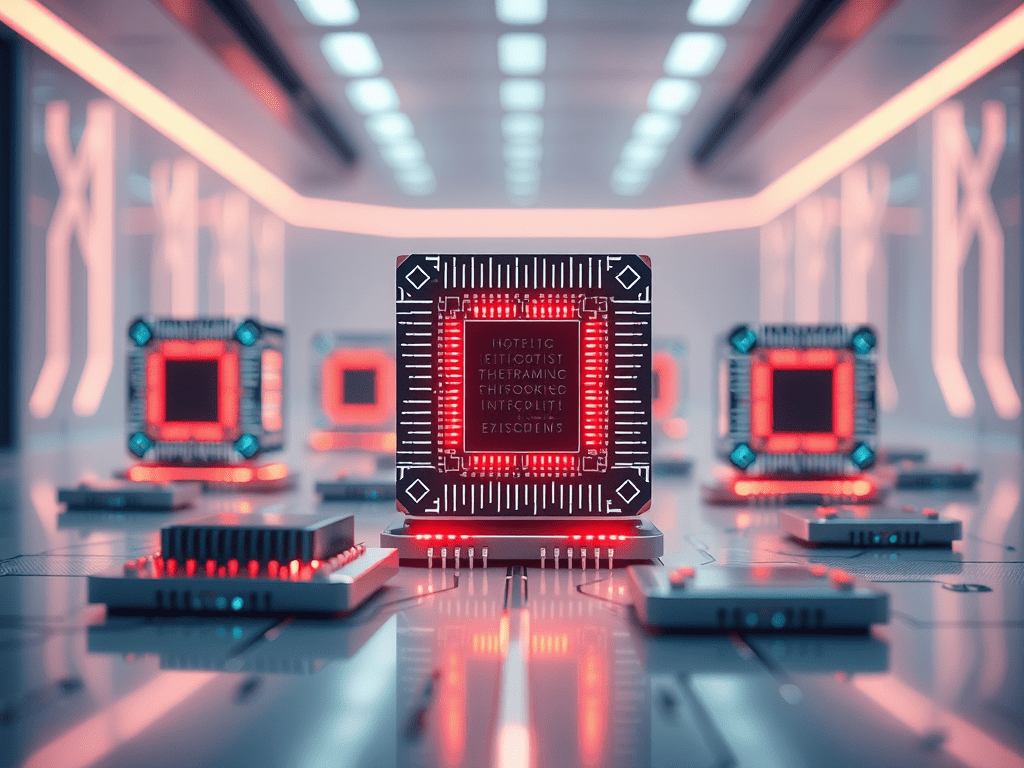
For more than a decade, GPUs (graphics processing units) have powered the artificial intelligence boom. From training massive language models to running advanced computer vision systems, the GPU has been the workhorse of AI…
…but as AI models grow larger and more complex, GPUs are hitting hard limits in energy, scalability and efficiency. The future of AI hardware may not be just “bigger GPUs”—instead, a wave of futuristic processors is emerging. Two of the most exciting are thermodynamic computing chips and neuromorphic processors, both inspired by physics and biology.
This article explores these next-gen architectures, how they could reshape AI beyond 2025, and what it means for developers, investors and tech enthusiasts.
🔥 What Is Thermodynamic Computing?
Thermodynamic computing uses the laws of physics—energy states and noise—to solve problems more efficiently than traditional silicon.
In 2025, Normal Computing announced the first thermodynamic processor (CN101). Unlike GPUs that brute-force through massive matrix multiplications, CN101 leverages stochastic sampling and “relaxation” toward low-energy solutions.
Key applications:
- Probabilistic AI models
- Bayesian inference & uncertainty estimation
- Generative AI sampling (diffusion models, image synthesis)
💡 Pro Tip: While thermodynamic chips aren’t on Amazon yet, experiment with edge AI accelerators like the NVIDIA Jetson Nano Developer Kit or Google Coral USB Accelerator to explore energy-efficient AI computing today.
🧠 Neuromorphic Chips: Brain-Inspired AI
Neuromorphic computing mimics the human brain, using spiking neurons and event-driven signals instead of dense matrix math. Intel’s Loihi 2 and research system Hala Point simulate over 1 billion artificial neurons, making them some of the largest neuromorphic platforms built.
Neuromorphic chips excel in:
- Always-on edge AI (voice assistants, anomaly detection)
- Low-power robotics and autonomous sensors
- Sparse data processing (real-world signals with gaps)
📘 Learn more: Books like Neuromorphic Computing and Beyond and Deep Learning with Python are great for developers exploring brain-inspired AI.
🌐 Photonic & Specialized AI Chips
Beyond thermodynamic and neuromorphic chips:
- Photonic computing (Lightmatter, Lightelligence) – Uses light instead of electricity, reducing heat and boosting bandwidth.
- Transformer-specific ASICs (Etched.ai’s Sohu) – Hard-wires LLM inference into silicon for faster, cheaper AI in narrow applications.
These trends point to a heterogeneous AI hardware future—GPUs will remain important, but new chip types will complement them.
⚡ AI Hardware Comparison: GPUs vs Thermodynamic vs Neuromorphic
| Feature | GPUs | Thermodynamic Chips | Neuromorphic Chips |
|---|---|---|---|
| Strength | Dense matrix math, deep learning | Energy-efficient sampling, Bayesian AI | Event-driven, ultra-low power AI |
| Energy Efficiency | High (datacenter cooling) | 10x+ lower for sampling workloads | Extremely low (milliwatts) |
| Maturity | Very mature, huge ecosystem | Early-stage (prototypes like CN101) | Research-to-pilot (Intel Loihi, BrainChip) |
| Best Use Cases | Large model training (LLMs, CV) | Probabilistic inference, generative AI | Edge AI, IoT, robotics |
| Availability | Consumer GPUs (RTX 4090) | Not yet available | Some research kits |
💡 Try today: Experiment with Jetson Nano or Coral USB Accelerator for hands-on edge AI.
⚡ Practical Use Cases for AI Enthusiasts Today
Even though futuristic chips are in labs, you can experiment now:
- Build an AI workstation: RTX 4090 GPU for model training
- Edge AI experiments: Google Coral USB Accelerator
- Robotics & IoT: Raspberry Pi 5 or Jetson Nano
- Data management: Samsung NVMe SSD
- Cooling solutions: Corsair Liquid Cooling
💡 Pro tip: Add a Synology NAS for large AI datasets and checkpoints.
📈 How to Prepare for the Post-GPU Era
- Developers: Modularize AI pipelines for specialized hardware.
- Investors: Watch startups like Normal Computing, BrainChip and photonics innovators.
- Tech enthusiasts: Experiment with edge accelerators, dev kits and high-efficiency GPUs.
💡 Tip: Learn thermodynamic and neuromorphic basics now; you’ll be ready when commercial products hit.
❓ Frequently Asked Questions (AI Hardware Beyond GPUs)
Q1: Will GPUs still matter?
Yes, GPUs will remain central for training large models. Future AI clusters will mix GPUs with specialized chips.
Q2: Neuromorphic vs Thermodynamic – what’s the difference?
- Neuromorphic: Brain-inspired, event-driven, low-power, edge AI
- Thermodynamic: Physics-inspired, probabilistic, generative AI
Q3: Can I buy a thermodynamic chip today?
Not yet. Experiment with Jetson Nano or Google Coral instead.
Q4: Are neuromorphic chips faster than GPUs?
Not in raw FLOPs, but extremely energy-efficient for real-time, low-power tasks.
Q5: How to start learning neuromorphic AI?
🛒 AI Hardware Buyer’s Guide: Mini Reviews
⚡ Beginner Friendly: NVIDIA Jetson Nano Developer Kit
Pros: Affordable, compact, great for vision & edge AI experiments
Cons: Limited compute compared to desktop GPUs
Check Price on Amazon
🖥 Serious Enthusiasts: NVIDIA RTX 4090 GPU
Pros: Ultimate GPU for model training, real-time AI rendering
Cons: Expensive, high power draw
Check Price on Amazon
🔌 Edge & IoT: Google Coral USB Accelerator
Pros: Portable, energy-efficient, ideal for low-power AI tasks
Cons: Limited to small models, not for heavy training
Check Price on Amazon
🤖 Robotics Projects: Raspberry Pi 5 Starter Kit
Pros: Affordable, flexible, large community support
Cons: Needs add-ons for serious AI
Check Price on Amazon
💾 Data Storage: Samsung NVMe SSD
Pros: Ultra-fast read/write, ideal for AI datasets
Cons: Can be pricey
Check Price on Amazon
❄ Cooling: Corsair Liquid Cooling Kit
Pros: Keeps GPUs/CPUs stable under heavy load
Cons: Requires installation knowledge
Check Price on Amazon
📚 Learning:
✅ Final Thoughts
The AI hardware landscape is shifting beyond GPUs. While futuristic chips aren’t yet consumer-ready, today’s dev kits and GPUs allow hands-on exploration. Start small, scale up and you’ll be ready for the post-GPU era.
✅ Key Takeaways
- GPUs remain central but are being challenged by physics- and brain-inspired chips
- Thermodynamic processors: Efficient probabilistic AI
- Neuromorphic chips: Brain-like efficiency for edge and robotics
- AI hardware future = heterogeneous: GPUs + thermodynamic + neuromorphic + photonics
- Experiment today with Jetson Nano, Coral USB, RTX GPU
🛒 Products Summary
- NVIDIA Jetson Nano Developer Kit
- Google Coral USB Accelerator
- Raspberry Pi 5 Starter Kit
- NVIDIA RTX 4090 GPU
- Samsung NVMe SSD
- Corsair Liquid Cooling Kit
- Synology NAS Storage
- Neuromorphic Computing and Beyond (Book)
- Deep Learning with Python (Book)
🙏 Thank you for reading!
Thank you for taking the time to explore the future of AI hardware with us! From GPUs to thermodynamic and neuromorphic chips, the world of AI is evolving faster than ever—and now you’re ahead of the curve.
If you enjoyed this article, don’t forget to share it with your fellow AI enthusiasts, and check out our recommended AI dev kits and books to keep learning.
👉 Stay curious, stay innovative and happy experimenting!



 tech, AI, Gaming, Online Income. ∞
Leave a comment